



Mono-material pouches are an important solution for sustainable snack packaging because they simplify packaging structures while maintaining the flexibility, barrier performance, and branding capabilities required for modern snack products.
Embalaje Zhongjia specializes in flexible packaging manufactured with impresión con tinta al agua. It provides customized stand-up pouches, flat-bottom bags, spout pouches, and zipper bags for food, daily-use products, and toys.
Why Are Mono-Material Pouches Important for Sustainable Snack Packaging?
Mono-material pouches are important for sustainable snack packaging because using one predominant polymer family can simplify packaging design and improve compatibility with established recycling streams when the local collection and recycling infrastructure supports that structure.
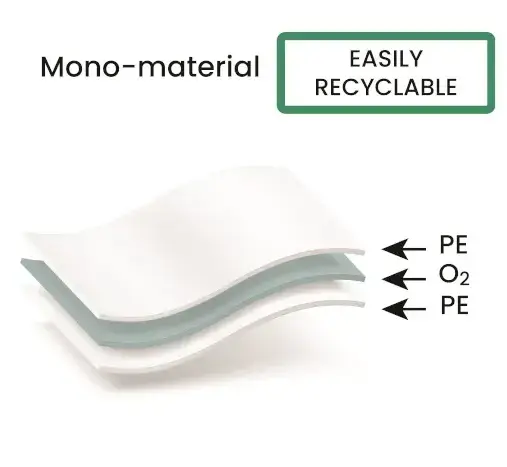
Traditional flexible snack packaging often combines several materials to achieve oxygen, moisture, aroma, puncture, and heat-sealing performance. These multilayer structures can provide excellent product protection, but separating different polymers after disposal can make material recovery more difficult.
A mono-material pouch approaches the problem differently. Instead of combining fundamentally different plastic families, the package is designed around one dominant material system, such as PE or PP, while functional layers, coatings, inks, closures, and other components must also be considered.
Recent research published in Environmental Impact Assessment Review compared multilayer and mono-material flexible packaging and found that mono-material films generally showed lower global warming potential in the studied applications, although the results varied by environmental category and depended strongly on end-of-life management.
This distinction is essential for buyers: mono-material does not automatically mean recyclable everywhere. Sustainable snack packaging must be evaluated against the recycling infrastructure and design-for-recycling requirements of the target market.
What Makes a Mono-Material Pouch Different from Conventional Flexible Packaging?
A mono-material pouch is designed around a dominant polymer family, while conventional flexible packaging frequently combines different polymers or other materials to achieve specific barrier and processing properties.
The structural difference can be summarized as follows:
| Packaging Structure | Typical Characteristics | Sustainability Consideration |
|---|---|---|
| Multilayer mixed-material pouch | Strong barrier and functional performance | Different materials can complicate recycling |
| Mono-PE pouch | PE-based structure | Designed for PE recycling pathways where available |
| Mono-PP pouch | PP-based structure | Designed for PP recycling pathways where available |
| Paper-plastic laminate | Paper combined with polymer layers | Separation can affect recovery |
| Aluminum-containing laminate | Alto rendimiento de barrera | Strong protection but more complex material recovery |
The goal of mono-material design is not simply to reduce the number of layers. It is to create a package whose components work within a compatible material system while still protecting the snack.
For B2B buyers, this means packaging development should start with the recycling target and product requirements together, rather than choosing a material first and asking about recyclability afterward.
How Does Mono-Material Packaging Support Snack Product Protection?
Mono-material packaging supports snack protection by combining compatible polymer layers and functional structures that can provide the moisture, oxygen, aroma, and mechanical protection required by different snack products.
Snack products are sensitive to environmental exposure. Depending on the product, packaging may need to control:
- Moisture ingress
- Oxygen exposure
- Pérdida de aroma
- Grease migration
- Light exposure
- Puncture and tear risks
- Heat-seal integrity
Different snacks require different protection levels.
| Snack Product | Key Packaging Requirement | Suitable Pouch Direction |
|---|---|---|
| Potato chips | Moisture and oxygen protection | High-barrier mono-material structure |
| Frutos secos | Oxygen and aroma protection | Barrier-focused pouch |
| Dried fruit | Protección contra la humedad | Moisture-resistant structure |
| Cookies | Moisture and mechanical protection | Durable heat-sealed pouch |
| Caramelo | Moisture and aroma protection | High-seal-performance pouch |
| Granola | Moisture and oxygen control | Reclosable stand-up pouch |
This is where sustainable snack packaging must be approached from a performance perspective. A package that uses less complex materials but allows excessive food loss is not automatically the better solution.
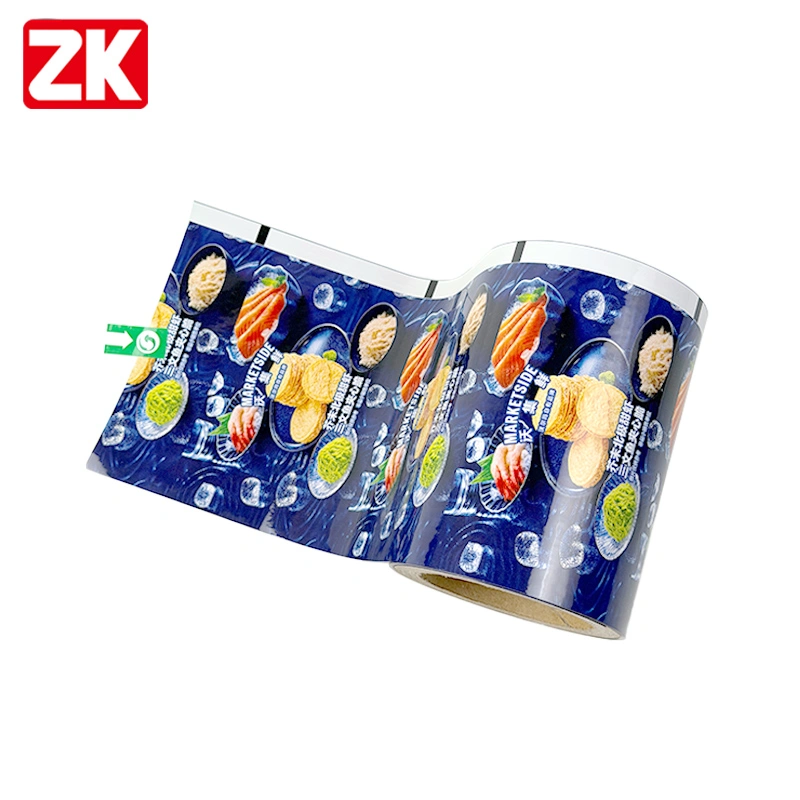
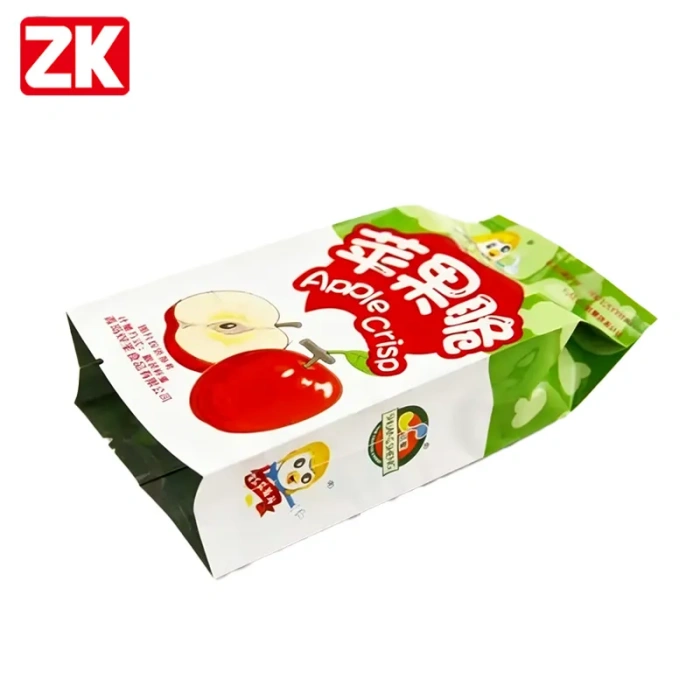
The packaging must first protect the food effectively, then optimize material compatibility and end-of-life performance.
Why Does Water-Based Ink Printing Matter for Sustainable Snack Packaging?
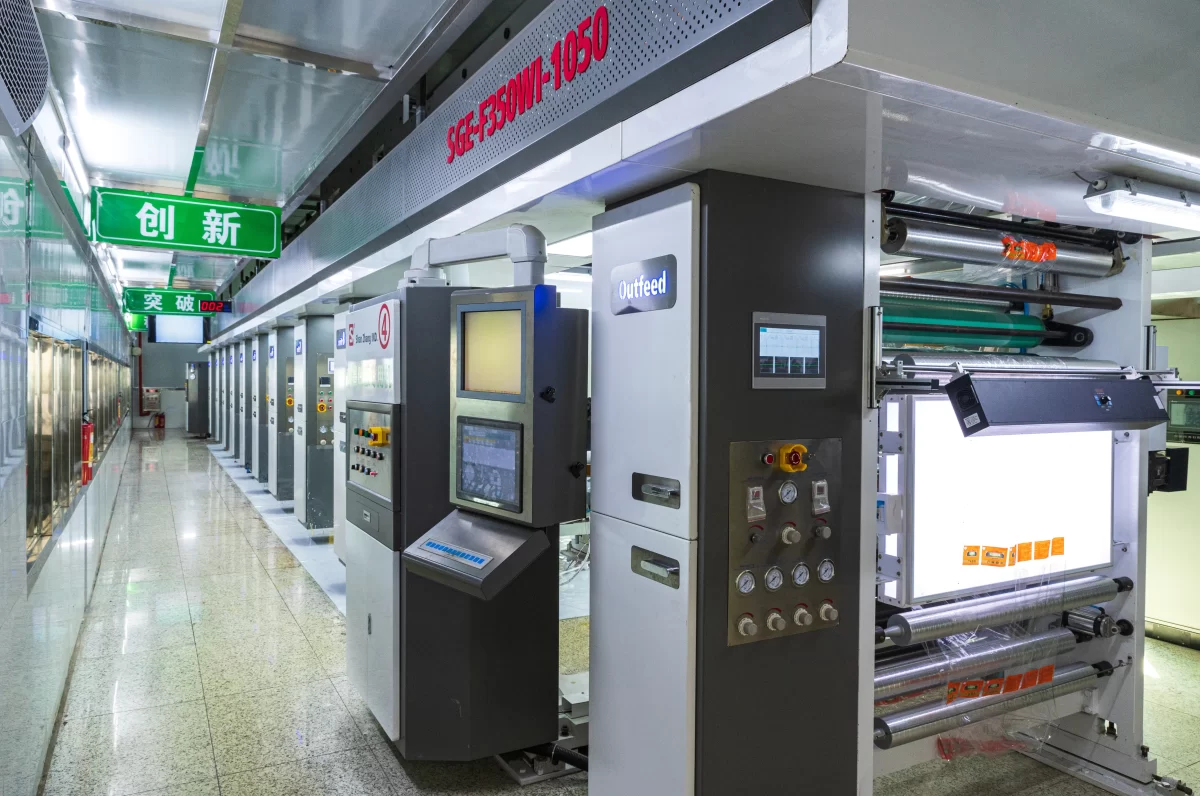
Water-based ink printing matters because it replaces conventional solvent systems with water-based ink technology and can reduce the volatile organic compound burden associated with certain flexible packaging printing processes.
For brands developing sustainable snack packaging, material selection and printing technology should be considered together.
Embalaje Zhongjia se especializa en impresión con tinta al agua for flexible packaging, making printing technology a central part of its sustainable packaging approach.
Water-based ink printing can provide several advantages:
| Printing Consideration | Water-Based Ink Approach |
|---|---|
| Ink carrier | Primarily water-based |
| VOC management | Supports lower-VOC printing strategies |
| Environmental positioning | Fits sustainability-focused packaging programs |
| Branding | Supports high-quality customized graphics |
| Aplicación | Suitable for flexible packaging printing |
The U.S. Environmental Protection Agency has documented flexible packaging printing requirements that include water-based inks with specified VOC limits as one compliance approach for certain regulated printing operations.
For snack brands, the important point is that sustainable packaging is not only about the plastic substrate. Printing inks, coatings, adhesives, closures, and other components also contribute to the overall packaging system.
How Does Water-Based Ink Printing Improve the Environmental Profile of Flexible Packaging?
Water-based ink printing can improve the environmental profile of flexible packaging by reducing reliance on solvent-based ink systems and supporting lower-VOC printing processes.
This approach is particularly relevant for food packaging manufacturers that want to combine attractive graphics with environmental objectives.
A complete sustainable packaging evaluation should therefore examine:
- Substrate structure — Is the material system compatible with the intended recycling pathway?
- Ink system — Is the printing technology aligned with the brand’s environmental requirements?
- Adhesives and coatings — Are they suitable for the intended packaging structure?
- Pouch components — Do zippers, spouts, valves, or other components affect recyclability?
- Food protection — Does the package maintain the required shelf-life performance?
- End-of-life pathway — Can the package actually enter a suitable collection and recycling system?
This six-point evaluation is a more useful procurement framework than simply labeling a pouch “eco-friendly.”
What Does the 2026 EU Packaging Regulation Mean for Sustainable Snack Packaging?
The EU Packaging and Packaging Waste Regulation (PPWR) makes recyclability and packaging design increasingly important for brands selling snack products in the European market.
The PPWR began applying on 12 August 2026. The European Commission states that all packaging must be recyclable by 2030, while the regulation introduces requirements covering packaging composition, recyclability, labeling, recycled content, and other sustainability factors.
The regulation specifically emphasizes design for recycling and considers whether packaging waste can be separated, sorted, and recycled into sufficiently useful secondary raw materials.
For snack brands, this makes packaging development more strategic.
| Buyer Concern | Why It Matters |
|---|---|
| Material structure | Influences recyclability |
| Packaging components | All components can affect the overall design |
| Labeling | Supports correct sorting |
| Recycled content | Increasingly relevant to EU requirements |
| Food-contact compliance | Important for food packaging |
| Supplier documentation | Helps demonstrate technical specifications |
The European Commission also reports that EU packaging waste was projected to grow by 19% by 2030 without further action, with plastic packaging waste potentially increasing by as much as 46%.
For brands exporting snacks to Europe, sustainable snack packaging should therefore be developed with future compliance requirements in mind rather than redesigned after market entry.
How Should Snack Brands Choose Between Mono-PE and Mono-PP Pouches?
Snack brands should choose between mono-PE and mono-PP pouches according to the product’s barrier requirements, pouch format, sealing process, mechanical performance, target recycling pathway, and local market requirements.
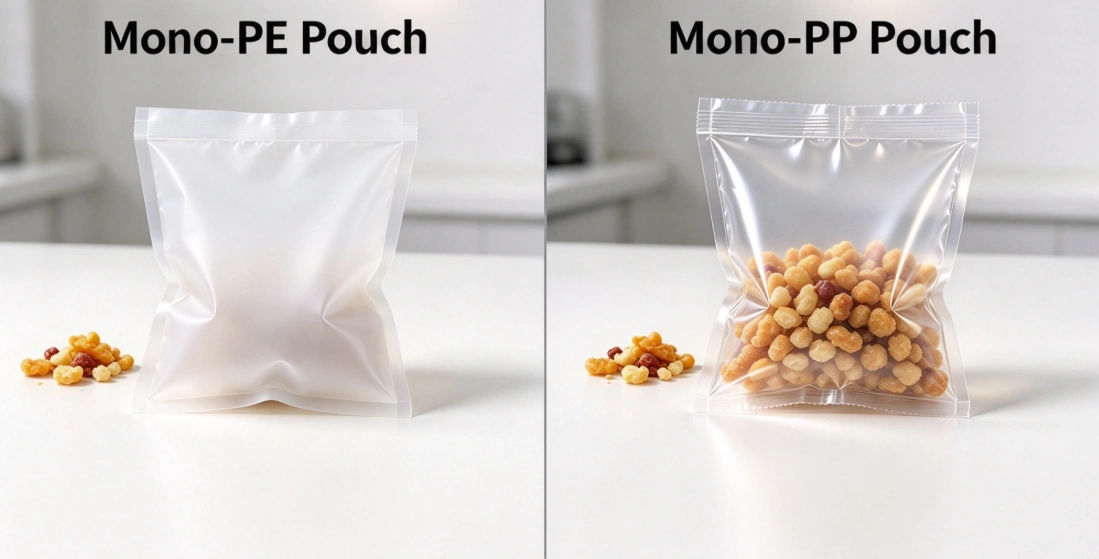
Neither polymer should be treated as universally superior. The correct choice depends on the complete packaging application.
| Factor | Mono-PE | Mono-PP |
|---|---|---|
| Flexibilidad | Excelente | Excelente |
| Pouch applications | Wide range | Wide range |
| Sealing performance | Strong | Strong |
| Recycling pathway | PE stream where supported | PP stream where supported |
| Product compatibility | Application-dependent | Application-dependent |
| Best selection method | Match product + market | Match product + market |
Un profesional packaging manufacturer should evaluate the complete structure rather than recommend a material based solely on marketing trends.
For international buyers, the target country is as important as the snack itself. A structure designed for one recycling system should not automatically be promoted as recyclable in another market without verification.
What Are the Main Benefits of Mono-Material Pouches for Snack Brands?
Mono-material pouches can give snack brands a combination of lightweight packaging, flexible branding, strong product protection, and a packaging structure designed around a more straightforward material stream.
Key advantages include:
1. Simplified Material Strategy
A mono-material structure reduces the number of fundamentally different polymer families in the package.
2. Lightweight Format
Flexible pouches use relatively little material compared with many rigid packaging formats while still providing a large printable surface.
3. Strong Branding Potential
Large front and back printing areas allow snack brands to communicate:
- Brand identity
- Product flavor
- Nutrition information
- Certificaciones
- Usage instructions
- Sustainability messaging
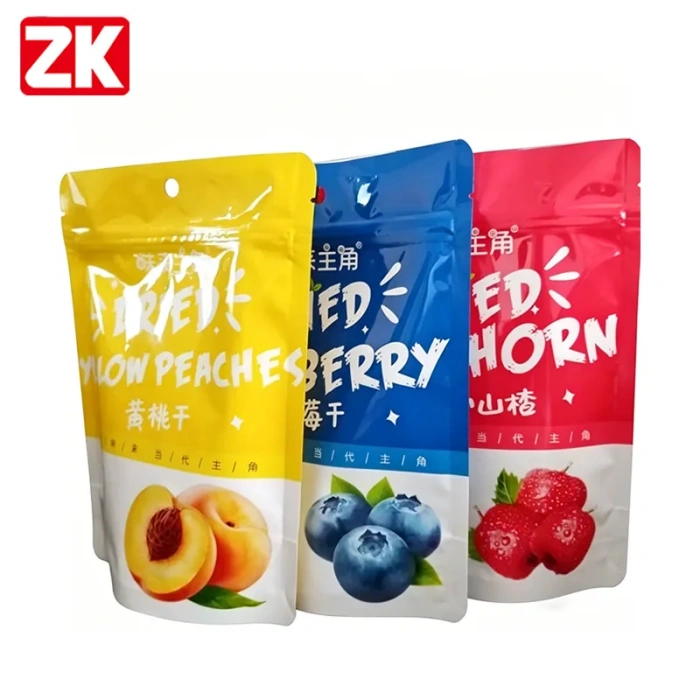
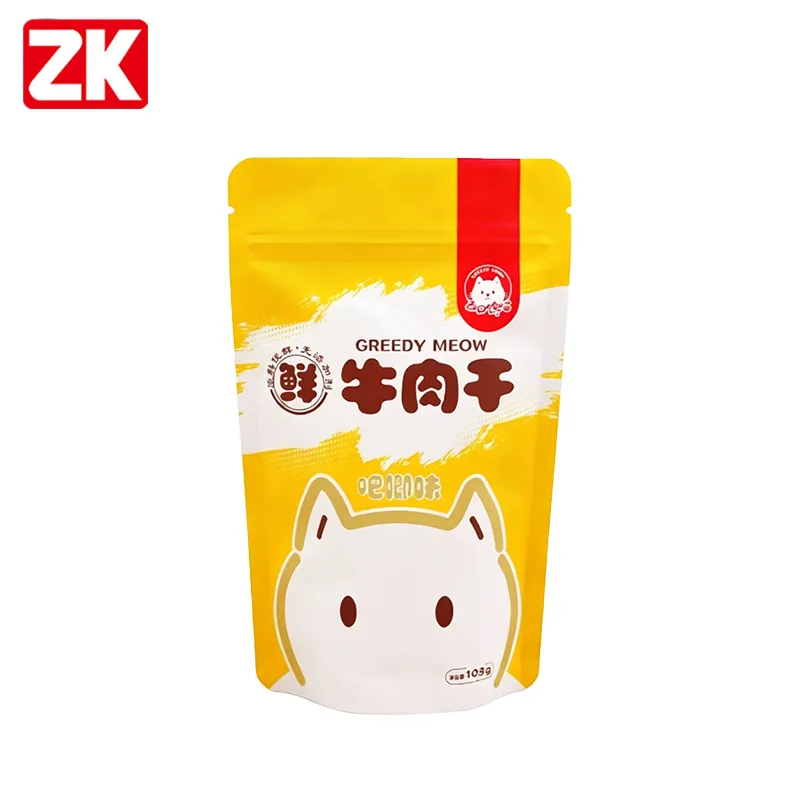
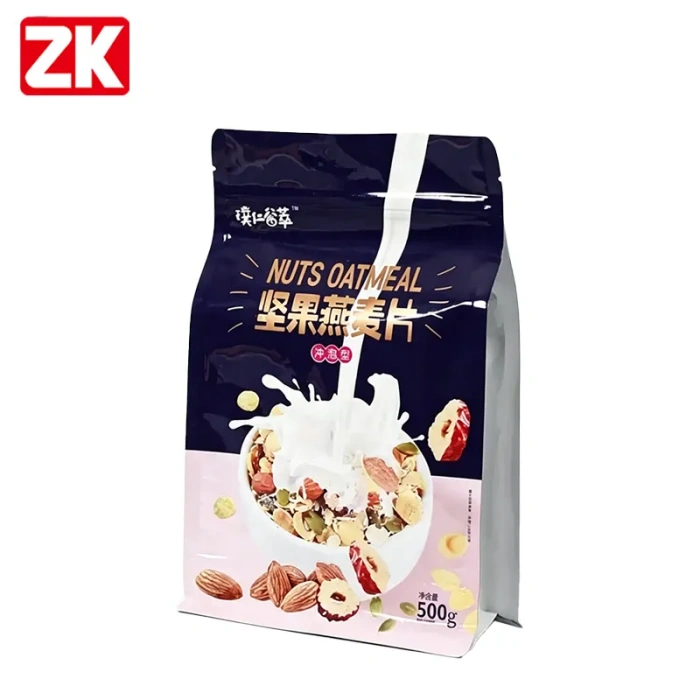
4. Flexible Pouch Formats
Mono-material structures can be developed for different formats, including:
- Bolsas verticales
- Zipper pouches
- Flat-bottom bags
- Custom snack bags
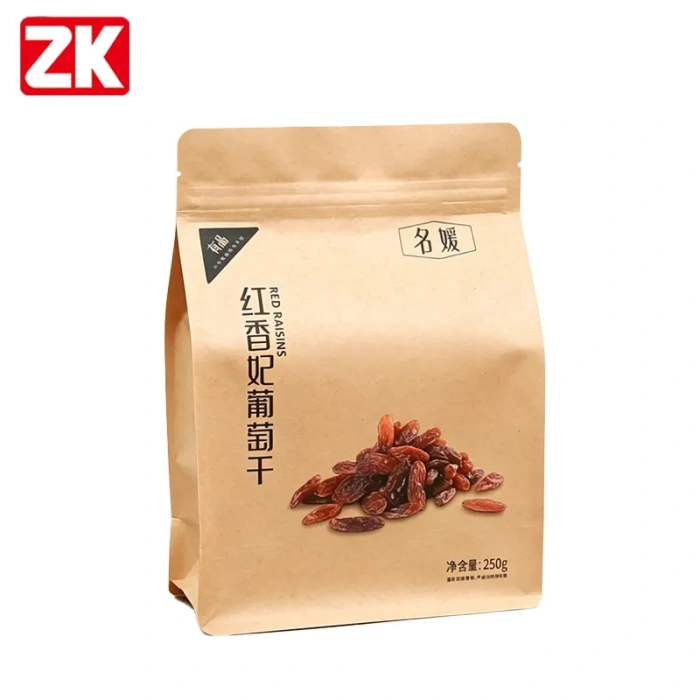
5. Compatibility with Sustainability Programs
When properly designed and supported by suitable recycling infrastructure, mono-material structures can help brands move toward design-for-recycling objectives.
What Is the Biggest Procurement Mistake When Buying Sustainable Snack Packaging?
The biggest procurement mistake is choosing packaging based only on the material label without evaluating the complete structure, printing system, components, product protection, and actual recycling pathway.
A pouch can be marketed as “mono-material” while still requiring careful review of:
- Printing inks
- Coatings
- Adhesives
- Cremalleras
- Boquillas
- Windows
- Labels
- Barrier treatments
This is the unique procurement perspective that many packaging guides overlook: the sustainability performance of a pouch is a system-level question, not a substrate-only question.
For example, a snack brand targeting Europe should ask the supplier not only whether the pouch is mono-PE or mono-PP, but also whether the complete pouch design aligns with the applicable design-for-recycling requirements.
The right supplier should be able to discuss the entire packaging construction with the buyer.
How Can Brands Develop Sustainable Snack Packaging Step by Step?
Brands can develop sustainable snack packaging by defining the product requirements first, selecting the target recycling pathway, optimizing the material structure, testing printing and sealing performance, and validating the finished pouch before mass production.
A practical B2B development process is:
- Define the snack product
Identify moisture, oxygen, aroma, grease, light, and mechanical protection requirements. - Define the target market
Identify the countries where the packaging will be sold and determine applicable packaging requirements. - Select the material family
Evaluate mono-PE, mono-PP, or another suitable structure according to product and market requirements. - Select the printing technology
Consider water-based ink printing for brands pursuing lower-impact printing solutions. - Develop the pouch format
Choose stand-up, zipper, flat-bottom, or another format according to retail and logistics requirements. - Test the complete package
Evaluate sealing, durability, barrier performance, appearance, and compatibility with the filling process. - Confirm production specifications
Finalize dimensions, material structure, printing colors, closures, packaging quantity, and quality requirements. - Begin bulk production
Use documented specifications and quality-control procedures to maintain batch consistency.
This process reduces the risk of selecting a packaging structure that looks sustainable but fails to meet the technical needs of the snack product.
How Can Buyers Request Sustainable Snack Packaging from Zhongjia?
Buyers can request sustainable snack packaging from Zhongjia by providing the snack type, pouch format, dimensions, required barrier performance, target market, printing requirements, and expected order volume.
To accelerate quotation and sample development, buyers should provide:
- Product type and filling weight
- Desired pouch format
- Bag dimensions
- Preferred mono-material direction, if known
- Required barrier performance
- Zipper or other closure requirements
- Printing artwork
- Target market
- Estimated order quantity
- Sustainability or compliance requirements
Zhongjia can then help assess the appropriate packaging construction and manufacturing requirements.
PREGUNTAS FRECUENTES
Q1. Are mono-material pouches recyclable?
Mono-material pouches are designed to support compatibility with a specific material recycling stream, but actual recyclability depends on the complete pouch construction and whether appropriate collection, sorting, and recycling infrastructure exists in the target market.
Q2. What is the difference between mono-material and multilayer snack packaging?
Mono-material packaging is built around one dominant polymer family, while conventional multilayer packaging can combine different polymers or other materials to achieve barrier and mechanical performance.
Q3. Is mono-material packaging always more sustainable?
No. Sustainability depends on the complete life cycle, including material production, manufacturing, transportation, product protection, food waste, and end-of-life management. A 2026 life-cycle assessment found that mono-material films generally performed better for some impact categories but not all, demonstrating the importance of application-specific evaluation.
Q4. What are the benefits of water-based ink printing?
Water-based ink printing supports lower-VOC printing strategies and provides an environmentally focused alternative for flexible packaging applications while maintaining customized brand graphics.
Q5. Can mono-material pouches include zippers?
Yes. Mono-material pouch designs can incorporate compatible zipper systems, but the zipper and other components must be evaluated as part of the complete package when assessing recyclability.
Q6. Are mono-material pouches suitable for chips and nuts?
Yes. Mono-material pouches can be developed for snack products such as chips and nuts when the selected structure provides the required moisture, oxygen, aroma, sealing, and mechanical protection.
Conclusión
Mono-material pouches provide a practical direction for sustainable snack packaging because they combine flexible packaging performance with a packaging structure designed around material compatibility and future recycling requirements. However, sustainable packaging should never be evaluated by the material name alone. The complete structure, printing inks, components, food protection, target market, and end-of-life infrastructure must all be considered.
Impresión con tinta al agua adds another important dimension to the packaging strategy. By combining mono-material structures with water-based ink printing, snack brands can develop packaging that addresses both material design and printing-process considerations.
Embalaje Zhongjia is a professional flexible packaging manufacturer specializing in impresión con tinta al agua, with four high-speed production lines, laboratory testing, more than 40 established business customers, and exports to over 20 countries. With stand-up pouches, flat-bottom bags, spout pouches, zipper bags, and customized packaging capabilities, Zhongjia provides integrated solutions for global food and snack brands.
If you are developing a new sustainable snack packaging line, contact Embalaje Zhongjia to discuss your product requirements, mono-material structure, water-based ink printing, pouch format, and OEM packaging needs.
