



Выбор правильного spout pouch packaging depends on product viscosity, particle size, barrier requirements, filling temperature, and dispensing needs. Sauces require reliable sealing and controlled flow, while purees may need wider spouts and stronger barrier protection.
Упаковка Zhongjia является профессионалом производитель гибкой упаковки специализирующийся на печать чернилами на водной основе. With four high-speed production lines, advanced equipment, and laboratory testing, we provide customized pouch solutions for food, daily-use, and other packaging applications.
This guide explains how to select suitable spout pouch packaging for different liquid products and what B2B buyers should consider before placing a custom packaging order.
What Is Spout Pouch Packaging and How Does It Work?
Spout pouch packaging is a flexible packaging format featuring a built-in pouring spout and cap, allowing consumers to dispense liquid or semi-liquid products without opening the entire package. It typically consists of a laminated pouch body, a sealed spout fitment, and a resealable closure.
The main components include:
- Pouch Body: Holds and protects the product through multiple laminated material layers.
- Spout: Provides a controlled opening for pouring or squeezing.
- Cap: Keeps the opening closed between uses and helps prevent leakage and contamination.
- Heat Seals: Connect the pouch panels and secure the spout to maintain package integrity.
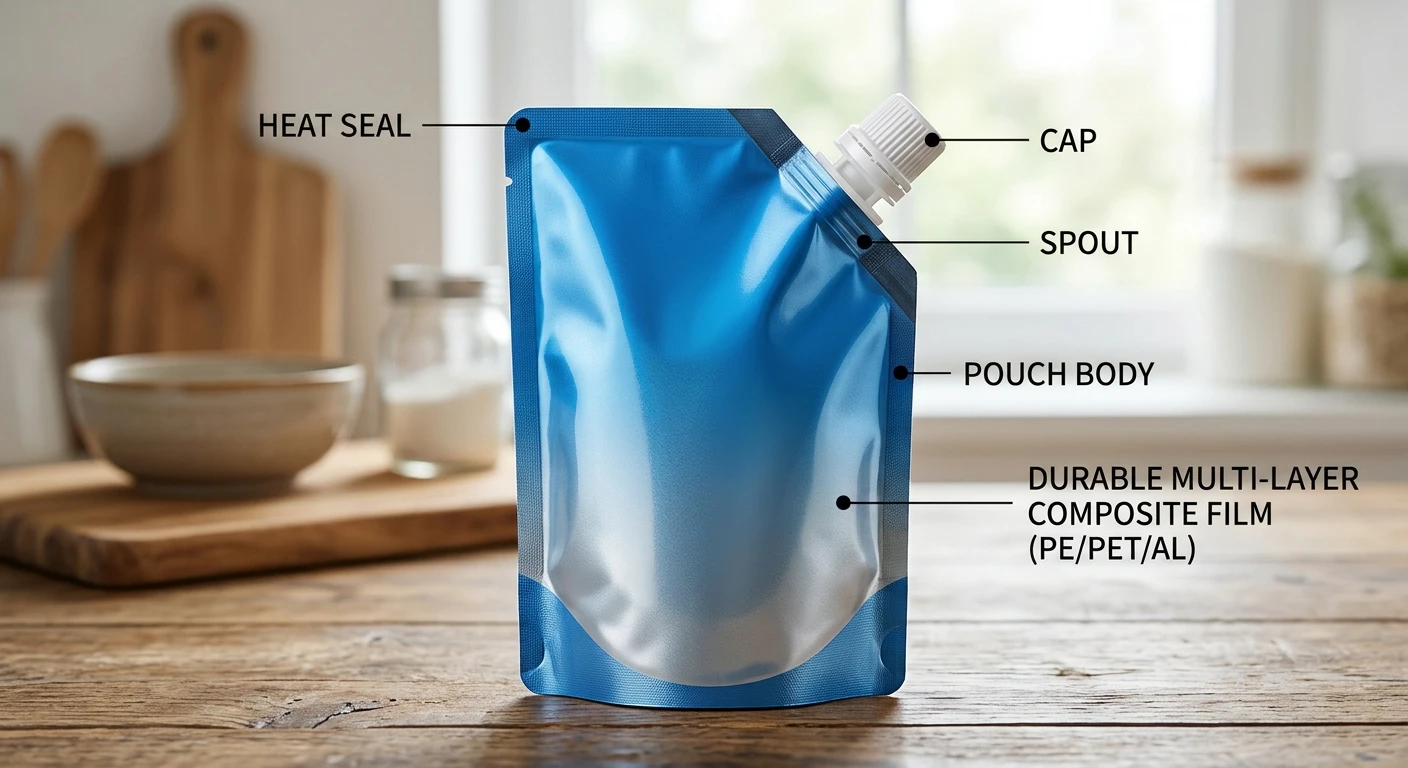
Compared with conventional bottles and rigid containers, spout pouch packaging offers a flexible structure that can be customized for different capacities, shapes, and dispensing requirements.
Its lightweight construction and flexible storage format also make it suitable for brands seeking convenient packaging and efficient product presentation.
What Products Are Suitable for Spout Pouch Packaging?
Spout pouch packaging is suitable for products ranging from thin liquids to thick semi-liquid foods. However, the product’s viscosity, particle size, chemical properties, and processing conditions determine the most appropriate design.
| Product Category | Общие приложения | Key Packaging Requirements |
|---|---|---|
| Sauces and Condiments | Tomato sauce, ketchup, chili sauce, salad dressing | Oil resistance, reliable sealing, controlled dispensing |
| Fruit Purees | Mango puree, apple puree, baby food | Suitable spout opening, food-contact safety, barrier protection |
| Beverages | Juice, fruit drinks, liquid concentrates | Oxygen protection, moisture control, filling compatibility |
| Cooking Ingredients | Cooking oil, syrup, liquid seasoning | Product compatibility, leak resistance, closure performance |
| Other Liquid Products | Liquid soap, detergent refills | Chemical compatibility, durable seals, convenient dispensing |
Упаковка для соусов и приправ
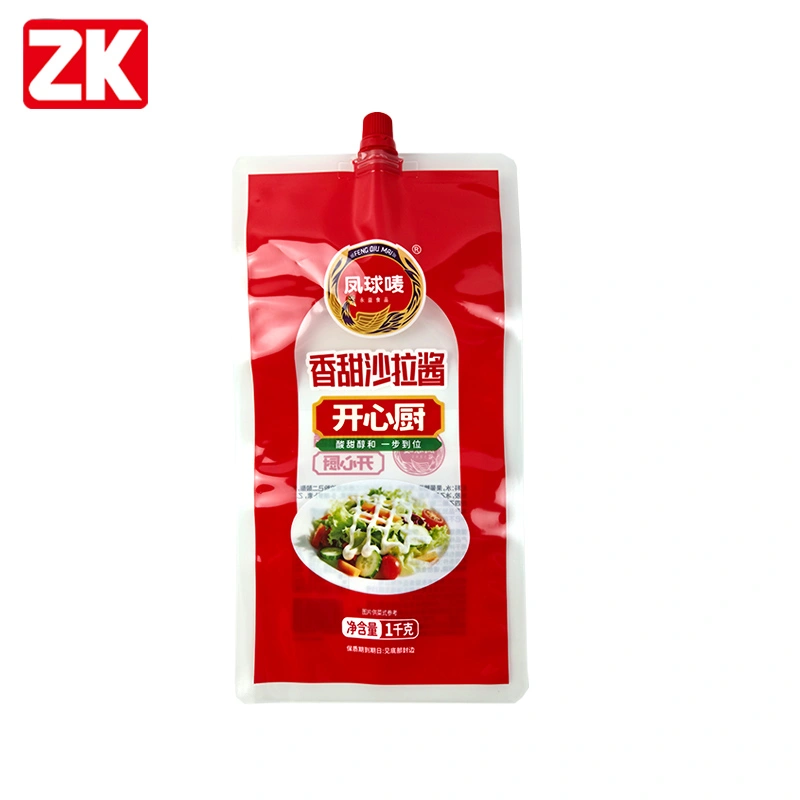
Sauces such as ketchup, tomato paste, and chili sauce are commonly packaged in spout pouches because consumers can squeeze out the required amount without using a spoon.
For these products, buyers should prioritize:
- Seal strength to prevent leakage during transportation.
- Suitable inner sealing materials for contact with acidic or oily ingredients.
- Spout openings that allow thick sauces to flow smoothly.
- Barrier properties that help maintain product quality.
Fruit Puree and Baby Food Packaging
Fruit purees and baby food often require convenient, controlled dispensing. A properly designed spout helps reduce spills and makes the product easier to consume.
The pouch should provide appropriate protection against oxygen, moisture, and light according to the product formulation and required shelf life. Food-contact compliance and suitable closure design are also essential considerations.

Juice and Beverage Packaging
Juices, flavored drinks, and liquid concentrates generally have lower viscosity than sauces. Their packaging requirements focus on oxygen protection, light sensitivity, sealing performance, and compatibility with the filling process.
For light-sensitive beverages, an appropriate barrier layer can help protect flavor, color, and product quality.

Other Liquid Products
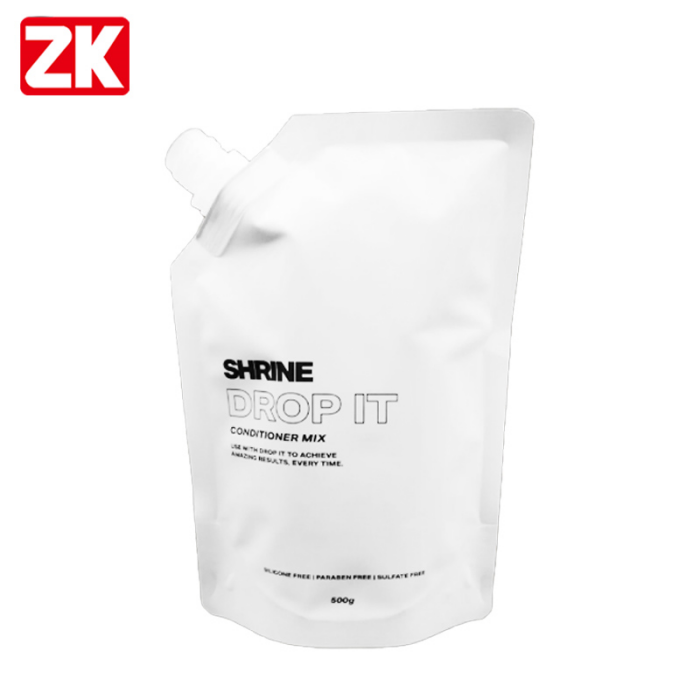
Spout pouches can also package cooking oils, syrups, liquid seasonings, and non-food products such as liquid soap and detergent refills.
For non-food applications, buyers should evaluate chemical compatibility between the product and the pouch’s inner sealing layer rather than automatically using a food packaging structure.
How to Choose the Right Material for Spout Pouch Packaging?
The right material structure depends on product sensitivity, shelf-life targets, storage conditions, and filling temperature. Different laminated films provide different combinations of printability, strength, flexibility, and barrier performance.
Common materials include:
| Материал | Main Function | Typical Application |
|---|---|---|
| ПЭТ | Printability, stiffness, dimensional stability | Outer printed layer |
| Физическая культура | Heat sealing, flexibility, moisture resistance | Внутренний герметизирующий слой |
| NY (Nylon) | Toughness and puncture resistance | Products requiring additional mechanical protection |
| VMPET | Enhanced barrier against oxygen, moisture, and light | Products requiring improved shelf-life protection |
| AL (Aluminum Foil) | Strong light, oxygen, and moisture barrier | Highly sensitive products |
Common Material Structures
1. PET/PE
This structure combines the printability and dimensional stability of PET with the heat-sealing properties of PE. It can be suitable for products with moderate barrier requirements, subject to actual product and filling conditions.
2. PET/VMPET/PE
This three-layer structure adds a metallized barrier layer to improve protection against oxygen, moisture, and light. It is suitable for products requiring enhanced barrier performance.
3. PET/AL/NY/PE
This structure combines aluminum foil with nylon and PE to provide strong barrier protection, mechanical durability, and heat-sealing performance. It can be considered for demanding packaging applications when the complete structure is validated for the intended filling process.
Important: No single laminate is suitable for every liquid product. Buyers should confirm material compatibility, sealing performance, and food-contact requirements before mass production.
Сайт U.S. Food and Drug Administration (FDA) explains that food-contact substances include packaging components, adhesives, and colorants. Materials used in food packaging must meet the applicable requirements for their intended conditions of use.
Similarly, the European Food Safety Authority (EFSA) explains that chemicals can migrate from food-contact materials into food and beverages. Therefore, material selection should consider migration safety as well as physical barrier performance.
How to Select the Right Spout Size and Pouch Design?
The appropriate spout size and pouch design depend on product viscosity, particle dimensions, serving size, and dispensing requirements. A narrow opening may work for thin liquids, while thick sauces and products containing particles need a wider opening to reduce flow restrictions.
Consider the following factors:
1. Spout Diameter and Opening Size
- Thin liquids such as juice can use smaller openings when the required flow rate allows.
- Thick sauces require larger openings to support smooth dispensing.
- Purees containing fruit pieces or other particles need openings that accommodate the largest particles.
2. Cap and Closure Options
The cap should match the spout fitment and provide a secure closure. Buyers should evaluate opening convenience, resealing performance, leakage resistance, and compatibility with the filling line.
3. Pouch Capacity and Dimensions
Capacity should reflect product volume, consumer usage, and filling requirements. Common applications range from small single-serving packs to larger family-size or refill packages. Actual dimensions should be confirmed through filling and packaging trials.
4. Pouch Structure and Appearance
A stand-up design provides shelf visibility, while custom pouch shapes and printed graphics help brands differentiate their products. Transparent windows may also be considered when product visibility is important, and the required barrier performance can be maintained.

What Should Buyers Consider Before Ordering Custom Spout Pouches?
Before ordering custom spout pouch packaging, buyers should confirm five key areas: product characteristics, material requirements, filling conditions, pouch specifications, and quality testing.
The following purchasing process helps reduce design errors and unnecessary production costs.
Step 1: Define the Product Characteristics
Provide the manufacturer with the product type, viscosity, particle size, pH where relevant, oil content, and storage requirements. These details help determine the appropriate inner layer and dispensing design.
Step 2: Confirm Material and Barrier Requirements
Identify the required protection against oxygen, moisture, light, and external contamination. Discuss the expected shelf life, distribution environment, and storage temperature before selecting the laminate.
Step 3: Specify the Filling Conditions
Confirm whether the product will be filled at ambient, hot-fill, pasteurization, or retort conditions. These processes have different temperature and sealing requirements. Do not assume that a standard pouch is suitable for every heat-treatment process.
Step 4: Finalize Pouch Dimensions and Printing
Provide the target capacity, pouch dimensions, spout position, opening diameter, cap requirements, and artwork. Discuss printing colors, surface finish, and branding requirements with the manufacturer.
Step 5: Test Samples Before Mass Production
Request representative samples and evaluate:
- Pouch dimensions and appearance.
- Print quality and color consistency.
- Seal and spout attachment strength.
- Leakage resistance under actual handling conditions.
- Compatibility with the intended filling equipment.
- Product stability under the planned storage conditions.
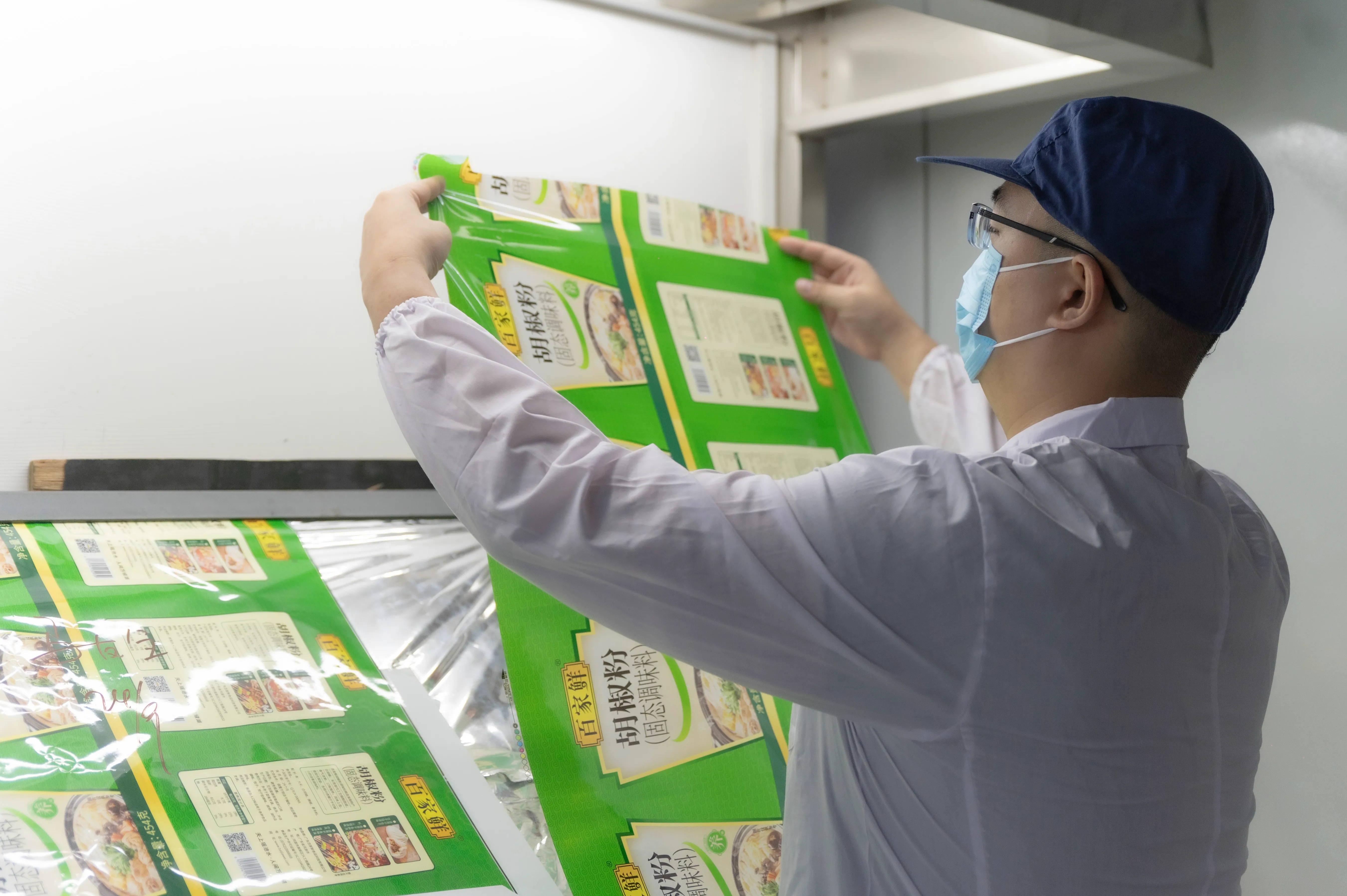
One important point is that flat-film barrier data alone cannot guarantee finished-package shelf life. The complete pouch, including seals, spout connections, cap, filling process, and storage conditions, must be evaluated together.
A Practical Selection Matrix: Match the Pouch to the Product
An important but often overlooked purchasing consideration is the relationship between product viscosity, particle size, and filling temperature. Instead of choosing a pouch based only on product category, buyers should evaluate these three factors together.
| Product Profile | Spout Design Priority | Material Selection Priority | Testing Priority |
|---|---|---|---|
| Thin, smooth juice | Controlled flow | Oxygen and light barrier | Leakage and shelf-life testing |
| Thick tomato sauce | Wider opening | Product compatibility and barrier | Dispensing and seal testing |
| Smooth fruit puree | Consistent flow | Oxygen and moisture barrier | Spout attachment and filling tests |
| Puree with particles | Particle-compatible opening | Puncture resistance and product compatibility | Flow and blockage testing |
| Cooking oil | Controlled pouring | Oil compatibility | Seal and leakage testing |
This product-first approach helps buyers avoid a common mistake: selecting a standard pouch structure before understanding the actual product and filling conditions.
Why Choose Zhongjia Packaging for Custom Spout Pouches?
Choosing an опытный производитель гибкой упаковки helps brands maintain consistent quality, customize packaging specifications, and manage bulk purchasing more efficiently.
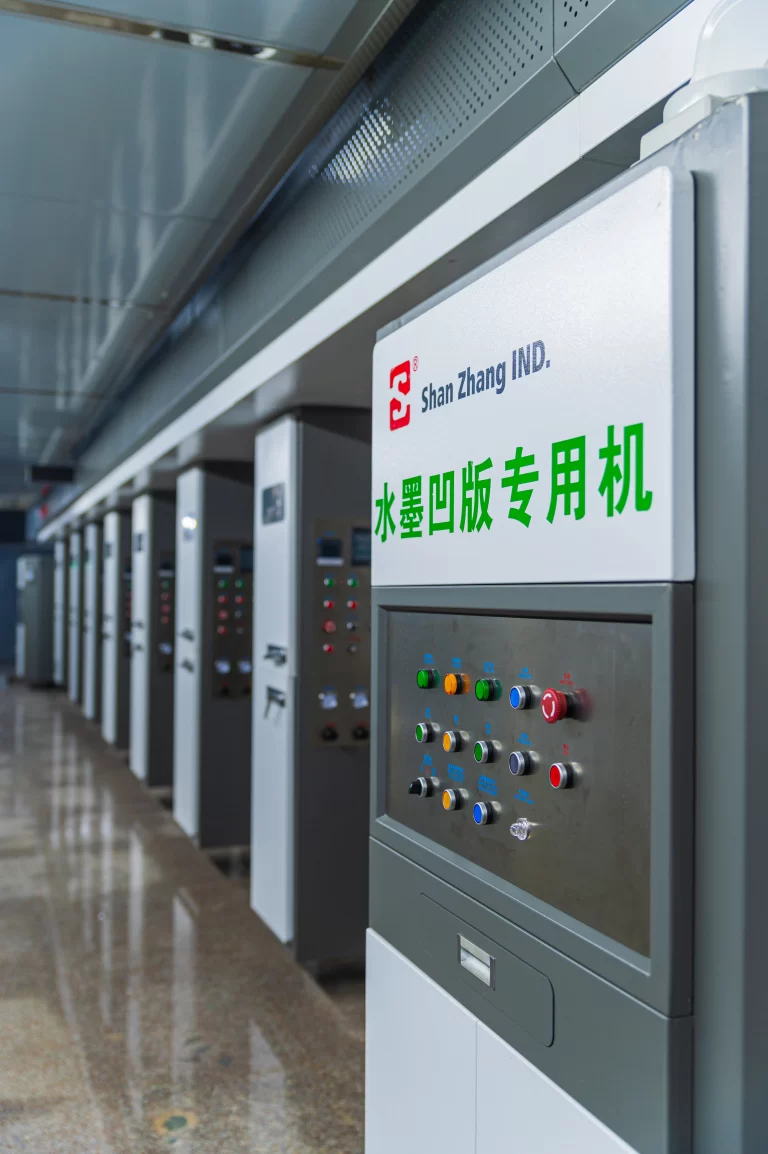
Упаковка Zhongjia специализируется на печать чернилами на водной основе for flexible packaging and serves more than 40 well-known businesses, with products exported to over 20 countries. Our factory operates four high-speed production lines supported by advanced equipment, systematic production management, and laboratory testing.
Our manufacturing capabilities support a range of packaging applications, including food, daily-use products, and toys.
Key advantages of working with Упаковка Zhongjia include:
- Water-Based Ink Printing: We use water-based ink printing technology to support packaging production with reduced reliance on conventional solvent-based inks. Water-based printing can help lower VOC emissions compared with conventional solvent-based printing systems, depending on ink formulation and process conditions. It provides an additional environmental consideration for brands developing packaging solutions.
- Custom Packaging Solutions: We manufacture stand-up pouches, flat-bottom bags, spout pouches, and zipper bags to meet different product and branding requirements.
- Stable Production Capacity: Four high-speed production lines support efficient manufacturing and consistent production management.
- Quality Control: Advanced equipment and laboratory testing help us monitor packaging quality and maintain production consistency.
- International Business Experience: Serving 40+ businesses and exporting to 20+ countries gives us experience supporting different packaging markets and customer requirements.
For food applications, water-based ink selection must also be evaluated alongside substrate adhesion, lamination compatibility, drying conditions, and the intended food-contact construction. Printing ink should not be assumed to be suitable for direct food contact simply because it is water-based.

Часто задаваемые вопросы
1. Are spout pouches suitable for hot-fill products?
Yes, spout pouches can be designed for certain hot-fill applications. However, the film laminate, sealant layer, spout material, cap, and sealing process must withstand the specified filling temperature. Buyers should confirm the complete package’s performance through application-specific testing.
2. Can spout pouches be used for thick sauces and purees?
Yes. Spout pouches are suitable for many thick sauces and purees. The spout opening should match the product’s viscosity and particle size to ensure smooth dispensing and prevent blockage.
3. How can manufacturers prevent spout pouch leakage?
Leakage prevention requires suitable sealing materials, accurate spout positioning, controlled heat-sealing parameters, and consistent quality inspection. Finished pouches should undergo appropriate seal-integrity and leakage tests.
4. What is the best material for liquid spout pouch packaging?
The best material depends on the product and its storage requirements. PET/PE can suit some applications with moderate barrier needs, while PET/VMPET/PE or PET/AL/NY/PE may be considered when stronger barrier protection is required. The final structure must be validated for the intended application.
5. Can spout pouches be customized for different capacities?
Yes. Manufacturers can customize pouch dimensions, capacity, spout position, opening size, cap design, printing, and surface finish according to the customer’s requirements and production feasibility.
6. Are water-based inks suitable for flexible food packaging?
Water-based inks are used in flexible packaging printing and can reduce VOC emissions compared with conventional solvent-based systems. However, suitability depends on the ink formulation, substrate, printing process, lamination system, and food-contact requirements. The complete packaging construction must be evaluated before production.
Заключение
Spout pouch packaging is an effective packaging solution for sauces, purees, juices, and other liquid products because it combines flexible storage, convenient dispensing, reliable sealing, and customizable designs. Selecting the right spout pouch requires more than choosing a convenient packaging shape. Buyers must evaluate product viscosity, particle size, material barrier properties, spout dimensions, filling temperature, and finished-package performance. Matching these factors before production helps improve dispensing convenience, protect product quality, and reduce packaging-related risks.
For food manufacturers and brand owners, choosing the correct packaging structure is essential to maintaining product quality and preventing leakage during transportation and storage. A well-designed pouch also improves product presentation and makes dispensing easier for end users.
However, not every liquid product needs the same pouch structure. Thick tomato sauce, smooth fruit puree, and thin juice have different flow characteristics and packaging requirements. Buyers should evaluate the product itself before deciding on materials, spout dimensions, pouch capacity, and printing options.
Упаковка Zhongjia является профессионалом производитель гибкой упаковки специализирующийся на печать чернилами на водной основе, with four high-speed production lines, laboratory testing, and experience serving 40+ businesses in more than 20 countries. We offer customized stand-up pouches, flat-bottom bags, spout pouches, and zipper bags for food and other packaging applications. Whether you need custom spout pouch packaging for sauces, fruit purees, or liquid products, contact Упаковка Zhongjia today to discuss your packaging requirements and request a factory-direct quote.


